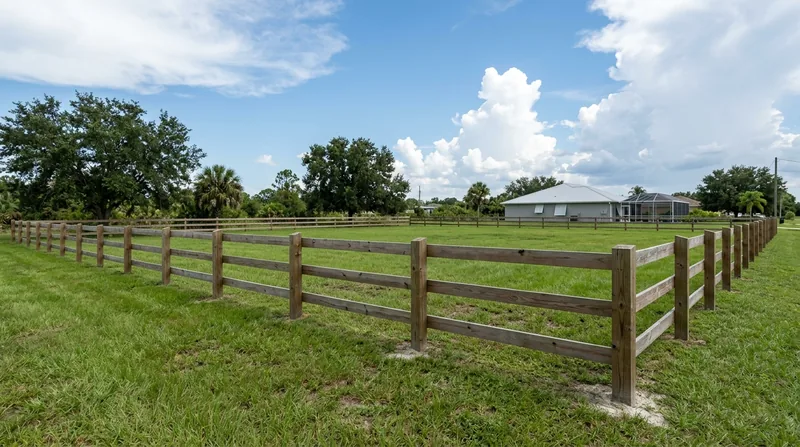




Farm fence installation in Cape Coral requires a clear understanding of the flat, sandy terrain, salt-air exposure, and the way property lines often run along canals or seawalls in this grid-based waterfront community. Unlike the sprawling acreage typical of ranch country, Cape Coral's residential lots are often smaller but still benefit from durable perimeter fencing, field wire, and ranch-style rail systems that withstand the Gulf Coast climate and hold up to salt spray and afternoon thunderstorms. Whether you own a few acres on the edge of the city, operate a small equestrian property, or maintain a rural-zoned parcel in the surrounding unincorporated areas, ranch rail fencing, no-climb horse fence, and pipe fencing provide the security and longevity that Cape Coral's weather demands. We have installed and repaired farm and ranch fencing across Cape Coral and the greater Southwest Florida region since 2015, working with property owners who need straight lines over long runs, properly braced corners, and gates sized for trailers and equipment. This guide covers the methods, costs, and considerations that matter when you are planning a fencing project on acreage.
Why Farm & Ranch Fencing Matters in Cape Coral's Coastal Environment
Cape Coral sits on low-lying, sandy and limestone-based terrain only a few feet above sea level, with salt air, high humidity, and intense afternoon thunderstorms that are routine during the summer wet season. Standard residential fencing materials degrade quickly in this climate, and livestock containment or property security on acreage demands fencing that handles wind, moisture, and salt spray without rotting, rusting, or sagging within a few seasons. Ranch rail, no-climb horse fence, and galvanized or powder-coated pipe fencing are engineered to survive these conditions, and their open design allows wind to pass through rather than catch and stress the posts and bracing.
- Ranch rail fencing withstands salt air and coastal moisture better than pressure-treated wood in exposed locations, and the open rail design minimizes wind load on posts.
- No-climb horse fence combines durability with visibility, allowing you to see across the property while keeping animals safely contained and preventing escape attempts.
- Galvanized or powder-coated pipe fencing resists rust in salt-air environments and requires minimal maintenance over 20+ years of service.
- Properly braced corners and posts set deep in concrete prevent sagging and leaning, critical in sandy soil where frost heave is less of a concern than post settlement and wind stress.
Each of these methods is chosen for the specific failure modes that dominate in Cape Coral, where salt exposure and wind load are the primary drivers of fence deterioration.
Key info: Cape Coral's canal-front properties and seawall lots experience higher salt spray exposure than inland areas. If your property borders open water or a canal, galvanized or powder-coated finishes are essential to prevent corrosion within the first 3 to 5 years.
For more information on how fencing performs under storm conditions, see our page on storm damage fence repair.
How We Install Farm & Ranch Fencing in Cape Coral: Step-by-Step
Our process begins with a site visit to understand your property layout, soil conditions, and the specific use case, whether it is livestock containment, property perimeter security, or equipment storage. We work from your existing survey or the property line you identify, and we always call 811 for a free utility locate before digging any post holes. From there, we lay out the fence line with string and batter boards, set posts deep in concrete on proper spacing, install horizontal stringers or rails, and finish with all hardware and bracing needed for the wind and salt-air environment of Cape Coral.
- Site survey and property line verification using your existing survey or your identified boundary, plus a call to 811 for utility clearance.
- Layout and marking of the fence line with string, batter boards, and measurement to ensure straight runs and proper post spacing.
- Post hole digging at depth appropriate to soil type and wind load, typically 30 inches or more in sandy Cape Coral terrain.
- Posts set in concrete footings, tamped or concrete-set depending on soil stability and the load the fence will carry.
- Installation of horizontal stringers, rails, or pipe framework, with anti-sag bracing and corner bracing installed before the fence is loaded.
- Final hardware installation, including all bolts, clips, hinges, and self-closing or self-latching gate hardware as specified.
The entire process is designed to create a fence that stands straight and secure for years, even as Cape Coral's sandy soil settles and coastal winds push against the structure.
Local example: A 5-acre property in the Lehigh Acres area with 400 linear feet of ranch rail fencing typically takes 5 to 7 working days from start to finish, including layout, post setting, rail installation, and gate hanging. Weather delays are common during the wet season (June through September), when afternoon thunderstorms can halt work for hours.
Learn more about our gate installation and repair services for property access and livestock movement.
Farm & Ranch Fencing Methods and Materials
| Approach | Description | Best for |
|---|---|---|
| Ranch Rail | 2x4 or 2x6 pressure-treated pine or cedar rails set horizontally between vertical posts, typically 3 or 4 rails high depending on animal type and containment needs. | Horses, cattle, and perimeter fencing where aesthetics and visibility matter; cedar offers better salt-air resistance than pressure-treated pine. |
| No-Climb Horse Fence | Welded wire mesh or rigid vinyl-coated wire panels mounted to posts, typically 4 feet to 5 feet high, with small apertures (2 inches x 4 inches or smaller) that prevent hooves from catching or climbing. | Equestrian properties and small livestock; combines safety with durability and is easier to repair than rail fencing if damage occurs. |
| Pipe Fencing | Galvanized or powder-coated steel pipe, typically 2-inch OD, bolted or welded to post sleeves; extremely durable and requires minimal maintenance in coastal environments. | High-wind areas, salt-air exposure, and properties where longevity and low maintenance are priorities; common in Cape Coral and waterfront areas. |
| Split Rail (Cedar) | Rustic cedar rails, hand-split or sawn, set in a post-and-rail configuration; offers natural appearance and superior salt-air resistance compared to pressure-treated alternatives. | Aesthetic perimeter fencing on acreage, rural properties, and areas where appearance is as important as function; cedar lasts 15 to 20 years in Cape Coral climate. |
| Field Wire or Pasture Fencing | Galvanized or vinyl-coated woven wire mesh or field fencing attached to wooden posts with staples or wire clips; lightweight and economical for large perimeters. | Temporary or semi-permanent containment, large acreage, and budget-conscious projects; requires more frequent inspection and maintenance than rigid systems. |
Farm & Ranch Fencing Cost in Cape Coral: What to Expect
Ranch rail and no-climb horse fencing typically start at $12 per linear foot for basic ranch rail on a straightforward property, though the actual cost depends on several concrete factors. Posts, materials, bracing, corner reinforcement, and gate installation all affect the final price, and the sandy, low-lying terrain of Cape Coral sometimes requires deeper post holes or additional concrete to achieve the stability needed in coastal wind. A 400-foot perimeter might run $4,800 to $6,000 or more, depending on the material chosen, the complexity of the layout, and whether the property has obstacles like trees, canals, or seawalls that complicate installation.
Pipe fencing is more expensive upfront, typically $18 to $25 per linear foot, but the longevity and minimal maintenance often justify the higher initial cost over 20+ years. A 400-foot pipe fence project might cost $7,200 to $10,000, but you will not need to repaint, treat, or replace boards for two decades. Split rail cedar fencing falls in the middle, around $15 to $20 per linear foot, and field wire or pasture fencing is the most economical option at $8 to $12 per linear foot, though it requires more frequent inspection and repair.
Several factors move the cost up or down from these starting points. If your property has dense vegetation, poor access, or difficult terrain, mobilization and site prep will add time and labor. Corner bracing, anti-sag hardware, and self-closing or self-latching gate hardware add to the material cost. Travel is included in our pricing for Cape Coral and surrounding areas, with no separate mileage fee. The best way to know what your specific project will cost is to request a free estimate, and we recommend getting 2 to 3 estimates so you can compare scope, materials, and timeline.
See our full pricing overview for more detail on how we structure estimates and what drives variation in cost.
Farm & Ranch Fencing Near Me: What Cape Coral Homeowners Should Know When Hiring
Hiring the right contractor for farm and ranch fencing means understanding insurance, licensing requirements, and how to evaluate a contractor's ability to handle the specifics of your property. In Florida, fence licensing is set at the county or municipal level, not by the state, so requirements vary across Greater Cape Coral. Some jurisdictions require a licensed general contractor for projects above a certain dollar threshold, typically $40,000 or more, so it is worth checking with your local building department and any HOA architectural board before you commit. What never varies is the need for a utility locate call to 811 before any digging, and that is a requirement by Florida law.
- Verify that the contractor is fully insured with general liability and workers' compensation coverage, and ask for a certificate of insurance before work begins.
- Check with your local building department and HOA to understand height restrictions, material rules, and any setback requirements that apply to your property.
- Confirm that the contractor will call 811 for a free utility locate before any post holes are dug, as this is required by Florida law.
- Ask for references from recent projects in Cape Coral or nearby areas, and follow up with those customers to ask about quality, timeline, and how the fence has held up.
- Get detailed written estimates from at least 2 contractors, including the material specification, post spacing, bracing details, and any warranty or guarantee offered.
- Understand that fence licensing here is set county by county, so if your project is large or complex, verify whether a licensed general contractor is required for your jurisdiction.
The contractor you choose should be able to explain why they are recommending a specific material, how it will perform in Cape Coral's salt-air and wind environment, and what maintenance schedule you should expect over the life of the fence.
Contact us for a free, no-obligation estimate at (239) 323-1805 or via our contact page, and we will walk you through the options and costs for your property.
Farm & Ranch Fencing in Cape Coral: Pricing Guide
| Service | Price | Details |
|---|---|---|
| Ranch Rail Fencing | Starting at $12/ft | Pressure-treated pine or cedar rails, posts set in concrete, includes layout and basic bracing on straightforward terrain |
| No-Climb Horse Fence | Starting at $14/ft | Welded wire mesh panels, 4 to 5 feet high, includes posts, hardware, and corner bracing for livestock containment |
| Pipe Fencing (Galvanized or Powder-Coated) | Starting at $18/ft | 2-inch steel pipe, bolted or welded assembly, ideal for salt-air exposure and high-wind areas with 20+ year lifespan |
| Split Rail Cedar Fencing | Starting at $15/ft | Hand-split or sawn cedar rails, superior salt-air resistance, rustic appearance, 15 to 20 year service life in coastal climate |
| Field Wire or Pasture Fencing | Starting at $8/ft | Galvanized or vinyl-coated woven wire, economical for large acreage, requires more frequent inspection and maintenance |
| Gate Installation and Hardware | On estimate | Trailer-sized gates, self-closing hinges, and specialty hardware priced separately based on size, material, and automation needs |
Indicative pricing, the exact cost depends on square footage, finish, and site access. Free personalized estimate within 24h at (239) 323-1805.


